

Table of Contents
- Why Bulky Garage Storage Cabinets Fall Short
- Garage Wall Storage Ideas That Free Up Floor Space
- Overhead Garage Storage: Reclaim the Ceiling
- Open and Industrial Shelving as Cabinet Swaps
- Bins, Totes, and Baskets: Storage Without the Box
- Small Garage Organization Ideas for Tight Spaces
- Cost, Safety, and Renter-Friendly Trade-Offs
- Frequently Asked Questions
Last Updated: October 18, 2026
Why Bulky Garage Storage Cabinets Fall Short
A bulky cabinet eats floor space first and delivers usable storage second.
Here's the core problem: a freestanding cabinet occupies the same footprint whether it's full or empty. Its doors need swing clearance. Its top collects dust you can't reach. And in a one-car garage, a single deep cabinet can block the path between the car door and the house door.
What most guides miss is that garage storage is a volume problem, not a furniture problem. You don't need more containers. You need to use the walls and ceiling you're already paying for. Once you think in cubic feet instead of square feet, the cabinet stops looking like the answer.
Below, we'll show you exactly which alternatives work for which items, what each one demands in installation, and where the hidden costs sit.
Garage Wall Storage Ideas That Free Up Floor Space
Garage wall storage ideas work because they move weight off the floor and onto structure that's already there. A wall system holds tools, bikes, and cords at eye level while keeping the parking bay clear. The catch is that walls have limits, and the wrong anchor turns a tidy wall into a repair job.
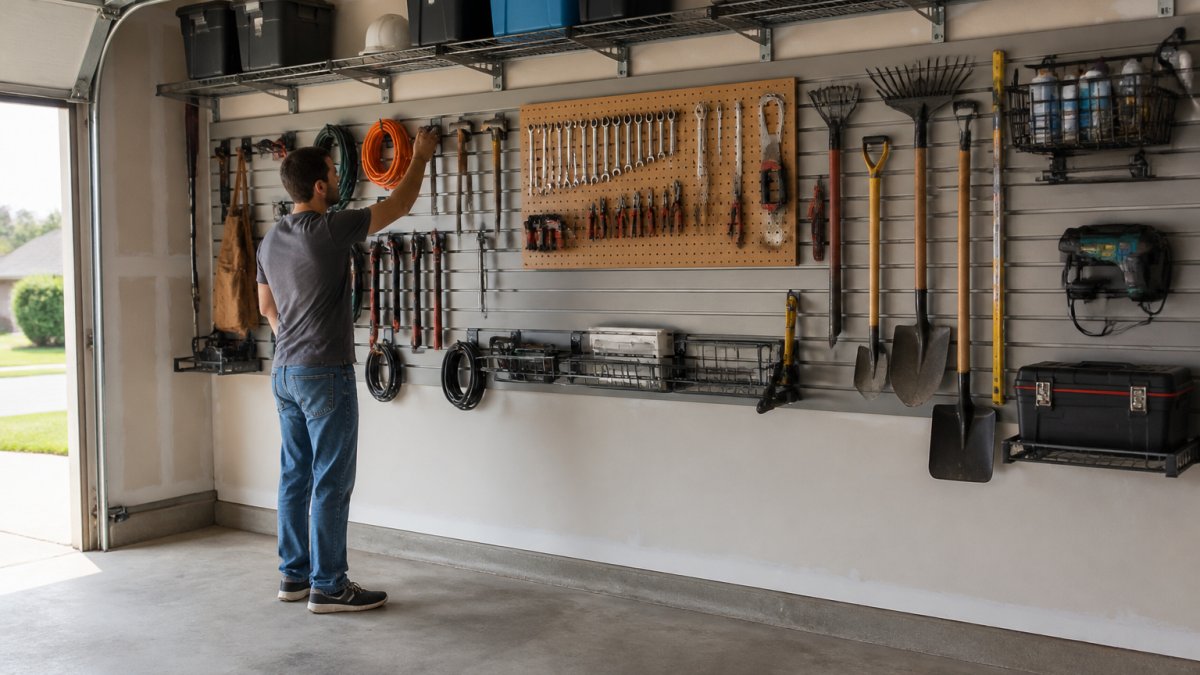
What most roundups skip is the part that decides whether a wall system actually works: how much floor it frees, what it can hold, and what it takes to install. The table below compares the four common wall options on those terms, using typical residential construction and manufacturer-stated ratings rather than best-case marketing numbers.
| Wall Option | Typical Floor Space Freed | Typical Load Rating | Installation Demand | Renter Reversibility |
|---|---|---|---|---|
| Slatwall panels | 12-20 sq ft per 8-ft section | 50-75 lb per hook or shelf, panel-dependent | High: stud or masonry anchoring, panel cutting | Low: screw holes and panel removal |
| Track rail | 6-12 sq ft per 4-ft rail | 25-50 lb per hook, rail-dependent | Medium: two to four anchor points into studs | Medium: unscrew and patch |
| Pegboard | 4-10 sq ft per 4x4 panel | 10-25 lb distributed, backer-dependent | Medium: plywood backer into studs | Medium: backer removal and patching |
| Wall-mounted hooks | 8-15 sq ft per bike or ladder | 50-100 lb per heavy-duty hook | Low to medium: lag into stud | Medium: patch and paint |
Slatwall and Track Systems
Slatwall is a panel with horizontal grooves that accept hooks, baskets, and shelves. You install it in a section, then rearrange the accessories whenever your storage needs change. That flexibility is the whole point: no drilling new holes every time you buy a new tool.
Track systems work the same way but mount as a single rail rather than full panels. They're cheaper for small areas and easier to remove. Both need solid anchoring into studs or masonry, not just drywall. A common pattern is to fasten a horizontal cleat across at least two studs, then mount the track or panel to the cleat so the load spreads across framing rather than a single fastener.
Garage Pegboard Organization for Small Tools
Garage pegboard organization handles the small stuff that clutters benches and drawers: screwdrivers, pliers, clamps, tape measures, and bits. A pegboard panel costs little, installs in an afternoon, and keeps every tool visible at a glance.
The mistake people make is mounting pegboard over drywall with plastic anchors. Loaded with tools, that fails. Fasten it to a plywood backer screwed into studs, and it will hold for years. Pegboard also collects dust and shows every gap, so plan the layout before you hang anything and keep the heaviest items low.
Installation and Renter Considerations
Wall systems split into three installation classes, and the class matters more than the product. Freestanding wall-leaning racks need no drilling but must be anchored to the wall to prevent tip-over. Surface-mounted systems (slatwall, track, pegboard) need stud or masonry anchoring and leave fastener holes. Overhead and ceiling-mounted systems need joist confirmation and leave the most visible patching work.
For renters, the practical ranking is track rails first, pegboard on a removable backer second, and full slatwall last. Track rails come down with a screwdriver and leave small holes that spackle fills. Slatwall panels are large, heavy, and awkward to remove without damaging drywall behind them. If your lease forbids drilling, a freestanding shelving unit anchored to a wall stud with a single removable strap is the least invasive option that still meets basic tip-over safety guidance.
Overhead Garage Storage: Reclaim the Ceiling
Overhead garage storage uses the ceiling zone above the car and the door track, which is often the largest unused volume in the room. Ceiling-mounted racks hold bins, holiday decorations, and camping gear that you access a few times a year. The trade-off is access: anything overhead needs a ladder, so it should hold what you rarely touch.
Load Limits and Installation Basics
Every overhead rack has a rated weight limit, and the ceiling structure matters more than the rack itself. Joists in older garages weren't framed for point loads, so you need to spread weight across multiple joists and confirm what your framing can take before hanging anything heavy.
Keep racks clear of the garage door's travel path. A rack that interferes with the door track is a safety hazard, not a storage solution. Measure the door's full open arc before you drill.
Open and Industrial Shelving as Cabinet Swaps
Open shelving and industrial shelving replace the closed cabinet with something you can see into and reach across. A steel shelving unit against a wall holds the same volume as a cabinet for a fraction of the cost, and it doesn't need door clearance. The downside is dust and visibility: everything is on display, for better or worse.
Industrial shelving is the heavy-duty end of the category. Wire or steel units with rated shelf capacities handle paint cans, power tools, and bulk goods. Adjustable shelves let you set heights to match what you're storing rather than forcing items into fixed compartments.
For a cleaner look, plywood cabinets built to fit a specific wall give you concealed storage without the bulk of a store-bought unit. They cost more in time than money, and they're permanent.
A common mistake is buying the cheapest shelving and overloading the top shelf. Load heavy items low, keep the top for light bins, and anchor the unit to the wall so it can't tip.
Bins, Totes, and Baskets: Storage Without the Box
Bins and totes turn open shelving and overhead racks into a working system. Clear storage bins let you see contents without opening them. Lidded totes protect against dust and pests. Baskets and jars handle small items on open shelves so they don't scatter.
Match the container to the environment. Garages swing between heat, cold, and humidity, so choose totes rated for temperature swings and keep anything moisture-sensitive off the concrete floor. Label every bin on at least two sides so you can find things without pulling everything out.
Shoeboxes and small stackable containers work well for hardware, craft supplies, and pet gear. Repurpose what you already own before buying new.
Small Garage Organization Ideas for Tight Spaces
Small garage organization ideas start with one rule: protect the parking bay first. If the car doesn't fit, the storage has failed no matter how neat the walls look. Plan clearance around the vehicle, the door swing, and the path to the house before adding anything.
Foldaway workbenches and wall-mounted work surfaces give you a bench when you need one and fold flat when you don't. That's the highest-value swap in a small garage because it converts dead wall space into a temporary work zone.
For renters, choose freestanding and removable options: track rails you can unscrew, freestanding shelving, and ceiling racks that mount with brackets you can patch over. Avoid adhesive products for anything with real weight.
Cost, Safety, and Renter-Friendly Trade-Offs
Cost per unit of storage is the number that actually matters, and it favors open systems. A wall track with hooks, a set of industrial shelves, and a stack of totes together usually cost less than one large cabinet and hold more.
To make that comparison usable, estimate cost per cubic foot of usable storage rather than sticker price. A typical 36-inch-wide, 24-inch-deep, 72-inch-tall cabinet holds roughly 30-36 cubic feet of gross volume, but door swing, fixed shelves, and dead space at the top cut usable capacity.
| Alternative | Relative Purchase Cost | Usable Volume per Footprint | Installation Cost | Reversible |
|---|---|---|---|---|
| Wall track and hooks | Low | High for hanging items | Low | Yes |
| Pegboard | Low | Medium | Low | Partly |
| Industrial shelving | Low to medium | High | Low | Yes |
| Overhead racks | Medium | High | Medium to high | Partly |
| Foldaway workbench | Medium | Medium | Low to medium | Yes |
| Built-in plywood cabinets | Medium to high | Medium | High | No |
Safety comes down to three checks: anchor everything that could tip, respect rated weight limits, and keep overhead loads away from the door path. A garage is a workspace with a vehicle in it, so falling objects and blocked exits are real risks, not hypothetical ones.
Renter-friendly options trade a little capacity for reversibility. Track systems and freestanding shelving come down cleanly. Permanent built-ins and plywood cabinets don't. Before installing anything permanent, check your lease for drilling and alteration clauses and confirm whether you're responsible for patching and repainting at move-out.
When you're outfitting the rest of the space, NextGen carries home and lifestyle products chosen for practical daily use, from storage-friendly decor to smart home gear that keeps a busy household running. Browse the collection and choose what fits your setup.
Frequently Asked Questions
What are the best alternatives to bulky garage storage cabinets?
Wall-mounted shelving, ceiling-mounted overhead racks, slatwall and pegboard systems, and stackable bins cover most needs without eating floor space. Open industrial shelving holds heavy items at a lower cost than cabinets, while totes and baskets handle small or seasonal gear. For renters, freestanding shelving units and ceiling racks that attach to joists avoid drilling into finished walls. Pick based on what you store: heavy tools want steel shelving, small parts want pegboard, and bulky seasonal items want overhead racks.
Are wall-mounted shelves better than garage cabinets?
Wall-mounted shelves cost less, install faster, and let you see what you own at a glance. Cabinets hide clutter and protect items from dust, but they take up floor space and cost more per square foot of storage. If your garage is tight or you rent, shelves and wall systems usually win. If you store chemicals, paint, or anything you want out of sight, a locking cabinet still makes sense for that specific category.
How can I organize a garage without cabinets?
Start by sorting items into heavy, small, and seasonal groups. Put heavy gear on low industrial shelving, small tools on pegboard or slatwall, and seasonal items in ceiling-mounted racks or labeled totes. Keep a clear walkway and leave room for car doors to open. Add a foldaway workbench if you need a work surface, and mount as much as possible at eye level or above so the floor stays open.
How can I keep garage storage off the floor in a rental?
Freestanding shelving units, stackable totes, and ceiling racks anchored to exposed joists keep gear off the floor without damaging finished walls. Tension-based wall tracks and adhesive hooks work for light items only. Check your lease before drilling into joists, and use rubber pads under shelving to protect the floor. For small garages, vertical stackable bins along one wall free up the most floor space with zero permanent changes.