

Table of Contents
- Why Pet Toys and Child Toys Follow Different Safety Rules
- Choking Hazards for Toddlers in Smart Pet Toys
- Toxic Chemicals in Pet Toys: What Parents Should Check
- Electronic Components, Battery Safety, and Smart Toy Risks
- Sanitization, Hygiene, and Cross-Contamination Between Pets and Kids
- How to Choose Smart Pet Toys That Are Safe Around Children
- Frequently Asked Questions
Last Updated: September 12, 2026
Why Pet Toys and Child Toys Follow Different Safety Rules
Pet toys and children's toys are governed by completely separate regulatory systems, and that gap is where most parents get into trouble. A rubber ball sold for a dog is not automatically safe for a toddler, even if it looks identical to one sold in the baby aisle. This guide from NextGen breaks down where the rules diverge, what hazards actually matter, and how to pick smart pet toys that hold up around kids.
CPSC toy safety standards are the benchmark for anything marketed to children under 12. These rules exist because children chew, swallow, and stress-test objects in ways pets don't.
What CPSC Toy Safety Standards Actually Cover
The Consumer Product Safety Commission enforces mandatory requirements for children's toys, including limits on lead and phthalates, small-parts bans for items intended for kids under three, and mandatory third-party testing (cpsc.gov). Manufacturers must certify compliance before a toy reaches a shelf. That certification is what separates a child-grade product from a pet-grade one.
Where Pet Products Fall Outside Federal Toy Rules
Pet toys are regulated as animal products, not children's products. They are not required to meet CPSC toy safety standards, carry age warnings, or pass small-parts testing. A toy can legally contain materials or detachable pieces that would never pass child-grade testing. That is the single most important distinction in this entire article.
Choking Hazards for Toddlers in Smart Pet Toys
Small parts are the leading physical danger when pet toys end up in a toddler's hands. Children under three explore objects by mouthing them, and any component that fits inside a toilet paper tube is a choking risk by standard safety benchmarks (cpsc.gov).
Small Parts, Batteries, and Detachable Pieces
Smart pet toys introduce hazards that a simple rope or plush does not. Watch for:
- Button cell or coin batteries that pop out of a loose compartment
- Detachable tails, faux feathers, and squeaker inserts
- Small screws and plastic caps that loosen with wear and tear
- Magnetic pieces that can attract each other if swallowed
A common mistake is assuming a sturdy-looking housing stays sturdy. Dogs chew. Repeated compression loosens battery doors fast.
Toxic Chemicals in Pet Toys: What Parents Should Check
Pet toys are not required to be non-toxic by child-grade definitions, so chemical exposure is a real concern when a toddler mouths a dog's toy. Focus on what the material is and whether it off-gasses.
Phthalates, Fire Retardants, and Off-Gassing
Many pet toys contain plasticizers, fire retardants, and stain guards that would face strict limits in a child's product. Chemical off-gassing is the process where these additives release into the air over time. New plastic smell in a sealed bag is a signal, not a selling point. Look for toys labeled non-toxic materials or food-grade ABS, and air out anything with a strong odor before it goes near a child.
Electronic Components, Battery Safety, and Smart Toy Risks
Smart pet toys add two risks that a rope or plush never had: a power source that can fail inside a chewed housing, and a wireless connection that can expose your household. Both matter more around children, who mouth objects and cannot be told to keep a device away from their face.
Why Pet-Grade Battery Compartments Fail Around Kids
Children's electronic toys are built around a child-resistant battery compartment, typically a door held by a screw or a mechanism that requires a tool or two independent motions to open. Pet toys are not. Most pet electronics use a snap-fit or single-slide compartment sized for a coin cell or a small rechargeable lithium cell, because the design goal is quick battery changes for the owner, not resistance to a determined toddler.
That difference creates three distinct failure modes:
- Access. A snap door that a dog's chewing loosens over weeks is often openable by a two-year-old's fingers. Once the cell is out, a coin or button cell is exactly the size and shape that lodges in a child's esophagus.
- Leakage. When a chewer punctures or crushes a lithium cell, the electrolyte inside is corrosive. It can burn skin and, if the housing is breached, contaminate the surface a child then handles.
- Swelling and heat. A damaged or overcharged cell can swell, split its casing, and run hot. A swollen compartment that no longer seals is both a burn risk and an access risk.
A practical inspection routine catches most of this before it becomes an incident. Once a week, press the battery door closed and try to slide it open with light finger pressure; if it moves, the toy is done. Look for hairline cracks around the seam, any bulge in the housing, and discoloration near the compartment. Never submerge an electronic pet toy to clean it, water in the compartment accelerates corrosion and can bridge the cell's contacts.
Securing the Wireless Connection Before a Child Touches the Toy
Most coverage of smart pet toys stops at "check the privacy policy." That is necessary but not sufficient. The device itself is a small networked computer, and the connection is the part you can actually control.
Start with the pairing layer. A toy that pairs over Bluetooth with no PIN, or that stays in discoverable mode indefinitely, can be connected to by any phone in range. Prefer devices that require a pairing code and that drop out of discoverable mode after setup. If the maker publishes firmware updates, install them, an unpatched device is the one most likely to have a known, published flaw.
Then look at what the app asks for. A pet toy that requests your contacts, precise location, or microphone access when its only job is to roll a ball is over-collecting. Deny permissions the toy's function does not require, and check whether the app lets you delete the data it has already stored. If there is no account-deletion path, treat that as a signal about how the maker handles everything else.
Finally, isolate the device. Put smart pet toys on a guest Wi-Fi network rather than the one your family's phones, laptops, and baby monitor use. That single step means a compromised toy cannot reach the rest of your home network. Change the default password on the toy or its hub if one is provided, and turn the device off when it is not in use, an unpowered toy collects nothing.
What to Do If a Battery Is Swallowed
If you suspect a child has swallowed a button or coin cell, do not wait for symptoms (poison.org). These cells can cause severe internal injury within a short window, and the standard guidance from poison control and pediatric emergency sources is to seek emergency care immediately rather than induce vomiting. Keep the toy and any packaging so the medical team knows the cell type and size.
Sanitization, Hygiene, and Cross-Contamination Between Pets and Kids
Sharing toys between a pet and a child creates a hygiene problem most parents underestimate, and the reason is mechanical rather than vague. A pet's mouth deposits saliva, dander, and oral bacteria onto the toy surface. A toddler then mouths that same surface, and a child's immune system is still developing. The transfer is direct, and it happens on the exact objects children put in their mouths.
What Actually Transfers, and How Long It Survives
The organisms of concern are the ones that live in a pet's mouth and on its coat. The practical risk is not that every contact causes illness, it is that repeated, low-level exposure is avoidable and the fix is simple.
Survival depends heavily on the surface:
- Porous materials, plush, rope, fabric, and untreated wood, trap moisture and organic matter, and bacteria can persist on them for extended periods. These are the hardest to clean and the worst candidates for any shared use.
- Non-porous hard plastic and sealed ABS are far easier to sanitize because there is nowhere for moisture to hide, provided the surface is intact and not scratched.
- Crevices and seams, battery doors, speaker grilles, charging ports, and the gap where two plastic halves meet, are where grime accumulates and where a quick wipe misses.
Cleaning Smart Pet Toys Without Damaging Them
The cleaning method has to match the material, and electronics add a hard constraint: most smart pet toys are not submersible, and the manufacturer's instructions usually say so.
| Surface | What to Do | What to Avoid |
|---|---|---|
| Sealed hard plastic | Wipe with a damp cloth and a mild soap, then dry fully | Soaking, dishwasher, harsh solvents |
| Plush or fabric | Wash per the tag; if untagged, hand-wash and dry completely | Leaving damp, moisture feeds growth |
| Battery compartment | Wipe the seam only, keep the door closed | Any liquid entering the compartment |
| Charging port | Dry-brush or wipe around, never inside | Pushing moisture into the port |
| Scratched or cracked housing | Retire the toy | Cleaning a compromised surface |
A scratched or cracked housing is a hygiene problem as well as a choking one: the damage creates pores that hold moisture and resist cleaning. When a toy reaches that state, replacement is the correct call, not a deeper scrub.
The Separation Rules That Actually Work
The single most effective control is physical separation, and it is easier to enforce with a system than with willpower.
- Keep pet toys and child toys in separate, labeled bins that a toddler cannot reach.
- Never let a toy move between the two bins, even briefly, once it is in a pet's mouth, it stays a pet toy.
- Wash hands after handling pet toys, and wash a child's hands after any contact with a pet or its belongings.
- Store smart pet toys powered off and out of reach when not in use, which also limits both hygiene and battery risk.
How to Choose Smart Pet Toys That Are Safe Around Children
Safe selection comes down to matching the toy to the least capable user in the house, which is usually the toddler. Run every purchase through this checklist:
- No loose or detachable small parts
- Battery compartment secured with a screw, not a snap
- Labeled non-toxic or food-grade material
- No strong chemical odor out of the package
- Published privacy policy if the toy connects to an app
- Sized too large to swallow
- Stored in a bin kids cannot reach
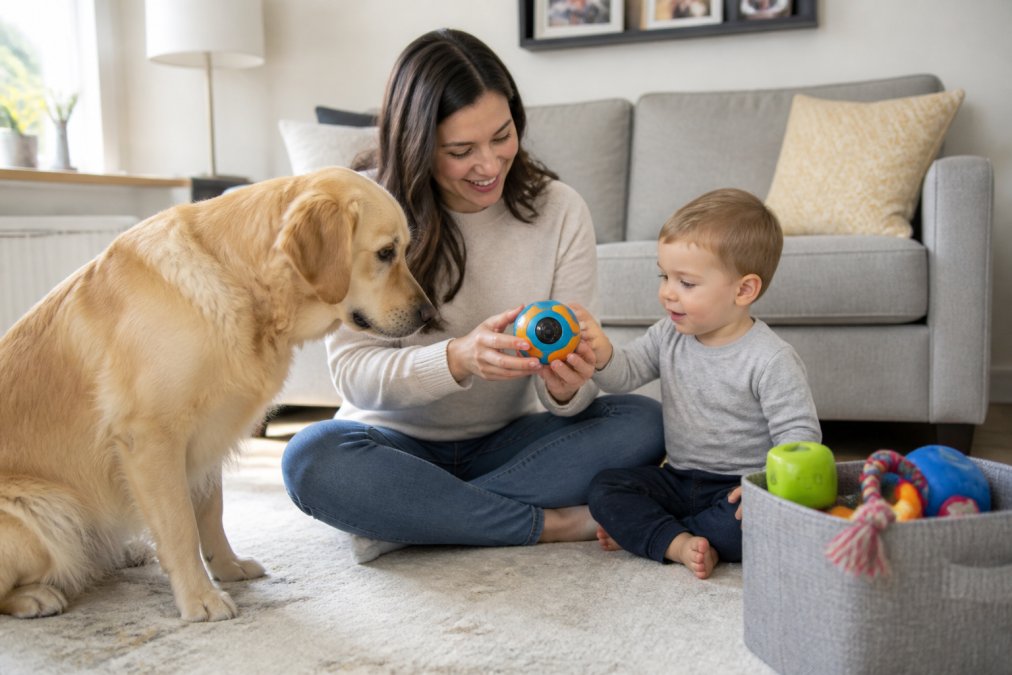
For families who want interactive options without the guesswork, NextGen carries rechargeable rolling ball toys and automatic feeders built for daily use. The ROJECO Automatic Cat Feeder keeps food contained and off the floor, while the USB Rechargeable Interactive Toy Ball offers a sealed, chewable design with fewer loose parts. Both are simpler to supervise than open-compartment electronics.


No toy replaces supervision. Even a perfectly chosen smart pet toy should be put away when a toddler is unattended, and every toy should be inspected weekly for cracks and loose parts.
Frequently Asked Questions
Are pet toys subject to the same safety regulations as children's toys?
No. Children's toys sold in the U.S. must meet CPSC toy safety standards, including third-party testing and CPSIA compliance for lead and phthalates. Pet toys are regulated as animal products, not children's products, so they skip those tests. That means a smart pet toy can legally contain small parts, battery compartments, or materials that would fail child-toy rules. Treat any pet toy as adult-supervised only around kids under three.
What are the risks of letting children play with electronic pet toys?
Electronic pet toys add hazards that plush or plastic toys do not. Button batteries can be swallowed and cause severe internal burns within two hours. Rechargeable lithium cells can leak or overheat if the casing cracks. Bluetooth-enabled toys may collect voice or usage data without parental consent. Wear and tear exposes wiring and small components. Keep electronic pet toys out of reach of toddlers and check battery compartments monthly for cracks or loose screws.
Do smart pet toys contain toxic chemicals or chemicals that could harm kids?
Some do. Toxic chemicals in pet toys can include phthalates in soft plastics, fire retardants in stuffed fillings, and lead in cheap painted parts. Pet toys are not required to meet CPSIA lead and phthalate limits, so contamination is possible. Look for toys labeled non-toxic materials, food-grade ABS, or third-party testing. Avoid strong chemical smells, which can signal off-gassing. Wash new toys before pets or kids handle them.
Can small parts in pet toys pose a choking hazard to toddlers?
Yes. Choking hazards for toddlers include detachable tails, squeakers, bells, and battery covers on pet toys. The CPSC small parts regulation uses a choke tube test for children's products, but pet toys are exempt. If a piece fits inside a toilet paper roll, it is a choking risk for a child under three. Check toys weekly for loose parts, and remove any smart pet toy from the floor when toddlers are crawling or walking nearby.
The honest challenge is that pet and child safety rules were never designed to overlap, so the burden lands on you. NextGen curates pet and home products with that gap in mind, offering rechargeable interactive toys and automatic feeders that are easy to inspect, easy to store, and easy to keep separate from kids' belongings. Browse the collection and choose smart pet toys that fit a household with both a dog and a toddler.