

Table of Contents
- What Makes a Toy Durable Enough for Aggressive Chewers
- Safe Materials for Dog Chew Toys: Rubber vs. Nylon
- Heavy Chewer Dog Toy Safety Tips
- How to Keep Dog Entertained While Working
- Signs of Wear and Tear: When to Replace a Chew Toy
- Dental Health and Behavioral Enrichment: The Hidden ROI of Durable Toys
- Size, Breed, and Budget: Choosing the Right Durable Toy
- Frequently Asked Questions
Last Updated: September 14, 2026
What Makes a Toy Durable Enough for Aggressive Chewers
Durable toys for aggressive chewers are chew products engineered to resist repeated, high-pressure biting without cracking, splintering, or breaking into pieces a dog could swallow. The difference between a toy that survives a week and one that lasts months comes down to material, thickness, and how well the shape holds up under jaw strength.
Most "indestructible" labels are marketing, not engineering. A toy earns the durable label when it keeps its structure after sustained chewing, not just after one session. That distinction matters more than any packaging claim.
We hear from owners whose dogs flatten "tough" toys in days. The fix isn't buying more toys, it's buying the right material in the right size. Below, we break down safe materials, safety rules, and how to tell when a chew toy has reached the end of its life.
Safe Materials for Dog Chew Toys: Rubber vs. Nylon
Safe chew materials fall into two main categories: rubber and nylon. Each has a specific job, and choosing the wrong one for your dog's chewing style is the fastest route to a destroyed toy or a vet visit.
Non-Toxic Rubber Compounds
Natural rubber and heavy-duty rubber compounds are the safest bet for aggressive chewers. Look for non-toxic, BPA-free, and phthalate-free labels, which confirm the material won't leach chemicals as your dog chews.
Rubber flexes under pressure, so it absorbs jaw force instead of shattering. That flex is why rubber works well for puppy teething and for dogs that like to gnaw rather than crush. The trade-off: softer rubber compounds wear down faster, so check for wear and tear weekly.
When Nylon Works and When It Doesn't
Nylon is the hardest common chew material, which makes it the go-to for power chewers who destroy everything softer. A dense nylon chew can hold up for months under heavy use.
But nylon is not for every dog. It's too hard for seniors, puppies, and dogs with existing dental issues. The American Veterinary Medical Association guidance on pet dental health notes that overly hard chews can cause tooth fracture, so nylon belongs only with dogs whose teeth are healthy and whose chewing style is aggressive but not frantic.
| Material | Best For | Chew Resistance | Watch Out For |
|---|---|---|---|
| Natural rubber | Teething puppies, moderate chewers | Medium | Wears down faster |
| Heavy-duty rubber | Aggressive chewers, interactive play | High | Can be punctured by sharp teeth |
| Nylon | Power chewers with healthy teeth | Very high | Too hard for seniors, puppies |
Heavy Chewer Dog Toy Safety Tips
Safety starts with supervision, but supervision alone is not a plan. The habits below are the ones that actually prevent the two injuries heavy chewers show up with most often: swallowed fragments and fractured teeth.
Match the toy to jaw strength, not body weight
A toy rated for a 40-pound dog will fail fast under a 90-pound power chewer, and the broken pieces become an ingestion hazard. Size up, not down. A toy should be too big to fit entirely inside your dog's mouth, if it can be swallowed whole, it is the wrong size regardless of what the package says. When in doubt, choose the firmer material and the larger size.
Inspect before every session
Run a thumb over the entire surface and check for cracks, punctures, deep gouges, or loose pieces. Pay attention to the ends and any seams, because that is where rubber and nylon fail first. A toy that passes the thumbnail test on Monday can fail by Friday under daily use.
Understand the hardness trade-off
This is the part most product pages skip. Harder is not automatically safer. A dense nylon chew resists destruction, but it also resists the tooth. A common pattern veterinarians describe is a dog who chews enthusiastically on a very hard object and later shows a fractured upper carnassial tooth, often a slab fracture that needs extraction. The American Veterinary Medical Association guidance on pet dental health notes that overly hard chews can cause tooth fracture, so nylon belongs only with dogs whose teeth are healthy and whose chewing style is aggressive but not frantic.
A practical test: if you cannot flex the toy at all with your hands, or if it feels like a rock against your own tooth, it is too hard for a dog with any history of dental problems, for seniors, and for puppies still losing teeth. Rubber that gives slightly under jaw pressure is the safer default for most aggressive chewers.
Skip toys with small parts
Squeakers, plastic eyes, rope knots, and glued-on components come loose first. For tough chewers, choose one-piece construction with no insertable parts. If a toy has a squeaker, treat it as a supervised-only toy, not a leave-behind.
Rotate and rest
No single toy should take nonstop abuse. Keep three or four durable toys in rotation and swap them every few days so each one gets recovery time and each one feels new. Rotation also lets you inspect each toy more carefully than you would if the same one were always in the dog's mouth.
Freeze for teething and sore gums
Freeze a rubber chew toy stuffed with treats before giving it to your dog. The cold numbs sore gums during teething and makes the chew last longer, which stretches the time between replacements.
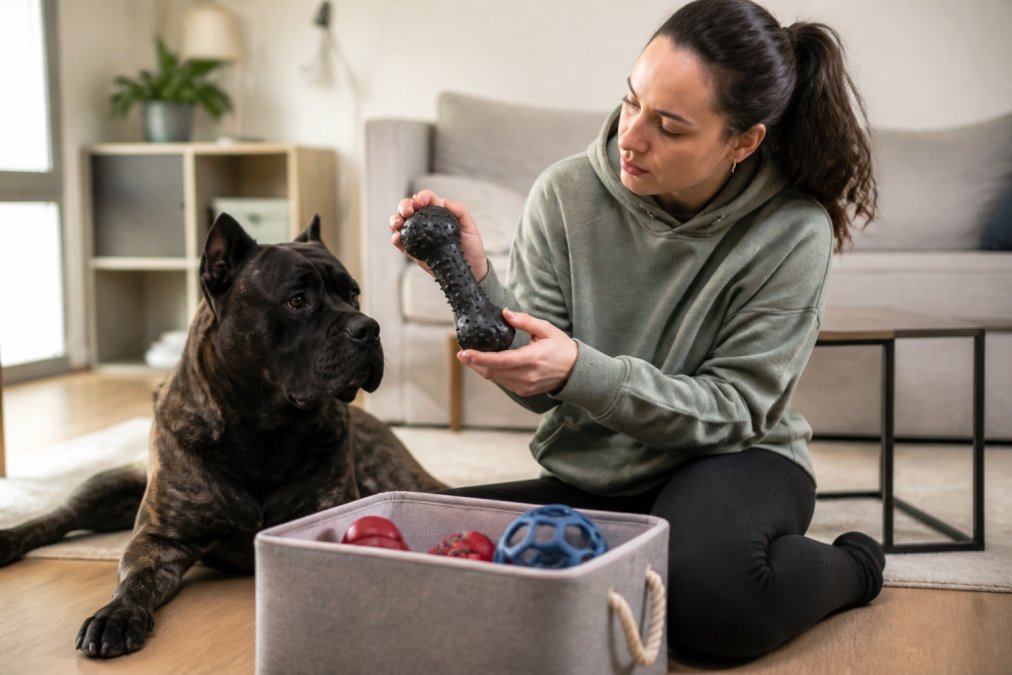
How to Keep Dog Entertained While Working
Keeping a dog entertained while you work comes down to mental stimulation, not just physical exercise. A bored dog with strong jaws will redirect that energy into destructive behavior, and your furniture pays the price.
The fix is enrichment: give your dog a job. Puzzle feeders and treat-stuffed rubber toys turn chewing into problem-solving, which tires a dog out faster than a walk. A common mistake is leaving one toy out all day. Dogs habituate to the same object within hours.
Toy rotation solves this. Keep three or four durable toys and swap them every few days so each one feels new. Pair rotation with a midday chew session and most dogs settle for the rest of the afternoon.
For owners who want to check in remotely, the ASPCA's pet care resources offer practical guidance on building a daily routine that keeps dogs occupied while you're away.
Signs of Wear and Tear: When to Replace a Chew Toy
Replace a chew toy the moment it shows deep cracks, missing chunks, or edges sharp enough to cut a gum. There is no fixed timeline, because chew resistance depends on the dog, the material, and how often the toy gets used. What most guides skip is the decision itself: how do you know a toy is past the point of safe use, and what do you do with it once it is?
The three-stage wear model
Think of every durable chew toy as moving through three stages:
Stage 1, Surface wear. The toy looks scuffed, the texture is slightly rougher, but the shape is intact and no material is missing. This is normal. Keep using it, keep inspecting weekly.
Stage 2, Structural wear. You can see deep gouges, small splits along seams, or a soft, sticky, or slick texture where the dog has gnawed through the outer layer. This is the warning stage. The toy is still whole, but it is one session away from failing. Move it to supervised-only use and start planning a replacement.
Stage 3, Failure. A chunk is missing, a crack runs through the body of the toy, edges are sharp, or the toy is now small enough to fit entirely inside your dog's mouth. This toy is done. Remove it immediately.
The thumbnail and flex test
Once a week, do two quick checks:
- Press a thumbnail into the surface. If it sinks in easily where it used to resist, the material has softened and is closer to failure than it looks.
- Try to flex the toy. A rubber chew that used to give slightly and now feels brittle, or that cracks instead of bending, is at the end of its life.
When to replace, by use pattern
A durable toy used daily by a heavy chewer may need replacing every few months. A toy used occasionally can last a year or more. A toy that has been through Stage 2 for more than a week or two should be replaced rather than nursed along.
Disposal: do not just toss it in the yard bin
Broken chew toys are a hazard to wildlife and to other pets. Cut rubber toys into pieces too small to be a choking hazard before discarding, or check whether the manufacturer runs a take-back or recycling program for worn chew toys. Never leave a failed toy in a place your dog can reach it again.
Cost per day: the math that changes the decision
Owners often hesitate to replace a toy that cost real money. Run the numbers instead. A durable toy that costs more upfront but lasts six months costs less per day than a cheaper toy that fails every two weeks. Divide the price by the number of days it survived. That number, not the sticker price, is what you are actually paying for chewing time, dental cleaning, and boredom relief.
Dental Health and Behavioral Enrichment: The Hidden ROI of Durable Toys
Durable toys do more than survive. They clean teeth and reduce anxiety, which is where the real return on your money shows up.
Chewing scrapes plaque off the tooth surface and massages the gums, so a dog that chews daily needs less dental intervention over time. The U.S. Food and Drug Administration's advice on safe chews for dogs recommends choosing chews matched to your dog's size and chewing style to avoid injury.
Enrichment works the same way. A dog with a satisfying chew outlet is calmer, sleeps better, and destroys less. That's the behavioral enrichment angle most product pages skip: you're not buying a toy, you're buying a routine that keeps your dog's mouth busy and their stress down.
Size, Breed, and Budget: Choosing the Right Durable Toy
Match the toy to the dog, not the price tag. A size-appropriate toy is one your dog can grip comfortably but can't swallow, and that single rule prevents most chew-toy injuries.
Breed and jaw strength matter more than weight. A determined terrier can out-chew a larger, gentler dog. When in doubt, choose the firmer material and the bigger size.
On budget, think in cost per month, not cost per toy. A cheaper toy that fails in two weeks costs more over a year than a durable one that lasts six months. Spending more upfront on heavy-duty rubber or dense nylon usually wins on longevity.
Frequently Asked Questions
What is the strongest chew toy for aggressive chewers?
The strongest options are usually made from heavy-duty natural rubber or tough nylon. Look for toys labeled for power chewers and made with non-toxic, BPA-free, phthalate-free materials. Rubber toys with thick walls and no hollow seams tend to last longest. Always match the toy's size to your dog's jaw strength; a toy that's too small can be swallowed. Check for wear after each session and replace at the first sign of cracking.
Are nylon chew toys safe for aggressive chewers?
Nylon can be safe if it's dense and designed for heavy chewers. Avoid thin or brittle nylon that can splinter. Always supervise your dog, because aggressive chewing can break off pieces that become ingestion hazards. Replace the toy when it becomes small enough to swallow or develops sharp edges. For dogs with very strong jaws, rubber may be a better choice to reduce the risk of tooth fracture.
How do I keep my dog entertained while I'm working?
Use a mix of interactive toys and puzzle feeders. Rotate toys every few days to keep them novel. Fill a durable rubber toy with treats and freeze it for longer engagement. A treat-dispensing puzzle can provide mental stimulation for 20-30 minutes. Schedule a midday walk or play session if possible. These strategies reduce boredom and destructive behavior while you work.
When should I replace a chew toy?
Replace a chew toy as soon as you see cracks, deep gouges, missing chunks, or exposed inner material. For aggressive chewers, inspect toys daily. Even durable toys may need replacement every few weeks to months, depending on the dog. A good rule: if you can fit a finger into a hole or the toy has lost more than a quarter of its original size, it's time for a new one.
Picking a chew toy that survives an aggressive chewer is a safety decision as much as a shopping one. NextGen curates pet products built for real daily use, including smart pet toys and durable chew options chosen to hold up under heavy chewing. If you want toys that keep your dog busy while you work and hold their shape for the long haul, NextGen makes it simple. Choose NextGen for durable pet essentials that fit your routine.