

Table of Contents
- Start With a Home Routine Audit
- Build a Daily Routine Checklist for Productivity
- Use Smart Home Automation for Daily Tasks
- Minimalist Home Organization Tips That Stick
- Make the Routine Work for ADHD and Low-Energy Days
- Get the Whole Household on the Same Routine
- Maintenance vs. Deep Cleaning: What Belongs in a Daily Routine
- Frequently Asked Questions
Last Updated: September 16, 2026
Start With a Home Routine Audit
A daily home routine audit is a one-week exercise: write down every task you actually do, then identify the three that consume the most time for the least benefit. Most people who want to simplify daily home routine skip this and jump straight to buying organizers or apps. That's backwards.
Track One Week of Tasks
For seven days, note what you do and roughly how long it takes. A notes app works fine.
- Morning: what you touch before leaving the house
- Midday: errands, pet care, tidying
- Evening: cooking, cleanup, prep for tomorrow
Find the Three Biggest Time Drains
Circle the tasks that repeat daily and eat the most minutes. These are your targets.
Build a Daily Routine Checklist for Productivity
A daily routine checklist for productivity is a short, written sequence of tasks tied to specific times, not a wish list. The best ones fit on an index card.
Morning Block: 20 Minutes That Set the Day
Anchor the morning block to things you already do, habit stacking attaches a new action to an existing one.
- Start coffee, then unload the dishwasher while it brews (5 minutes)
- Feed pets and refill water bowls (3 minutes)
- Wipe kitchen counters and clear the sink (4 minutes)
- Set out anything needed for dinner (5 minutes)
- Scan the day's calendar and pick your top three tasks (3 minutes)
Evening Reset Ritual: 15 Minutes Back
The evening reset ritual is a fixed 15-minute pass through the house that returns it to a neutral state before bed. Do it at the same time every night so it becomes automatic rather than a decision.
- Dishes into the dishwasher, not the sink
- Counters and table cleared
- Pet area checked and refreshed
- Tomorrow's clothes and bags staged
- Lights off, phone charging outside the bedroom
Use Smart Home Automation for Daily Tasks
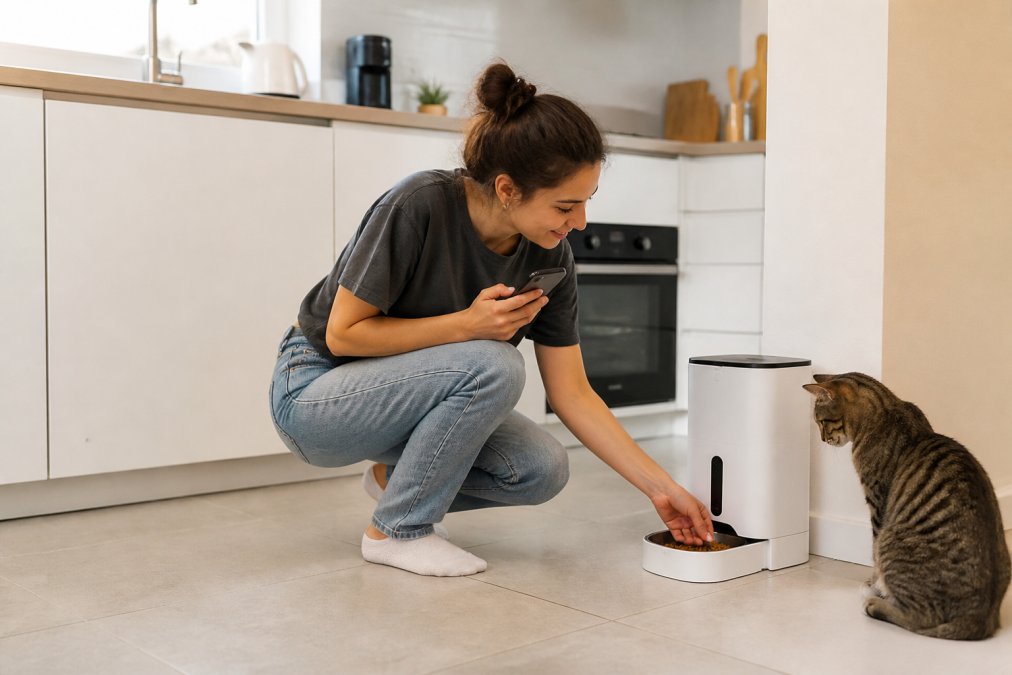
Smart home automation for daily tasks means letting a device handle a recurring chore on a schedule so it stops occupying your attention. The goal isn't a connected house. It's fewer decisions.
The Automation Filter: What to Automate First
Before you buy anything, run each candidate chore through four questions. Fail any, skip it.
- Does it recur on a predictable schedule? Daily or several times a week beats occasional. A once-a-month task rarely justifies a device.
- Is it time-boxed or attention-boxed? Attention-boxed chores ("I have to remember to do this") cost more than their clock time. Those are the best candidates.
- Does it have a clear done state? "Feed the pet" is binary. "Tidy the living room" is not, automation struggles with judgment calls.
- Will you still do it manually if the device dies? If the answer is no, you've created a dependency, not a simplification.
Three Budget Tiers, Not One Price Point
Automation doesn't require a renovation or a premium device. Match the tier to the chore's actual cost to you.
- Zero-cost tier (free): Phone alarms and recurring calendar events. A 7 p.m. "evening reset" alarm automates the decision to start, which is often the hardest part. Smart plugs you already own can schedule a lamp or a coffee maker. No purchase required.
- Low-cost tier (under about $50): Basic automatic pet feeders with programmable LCD timers, mechanical plug timers for fans and holiday lights, and entry-level robot vacuums for hard floors. These handle single, simple, recurring jobs.
- Higher-cost tier (roughly $150 and up): WiFi-connected feeders with app control and portion scheduling, robot vacuums with mapping and self-emptying, and connected appliances. Buy here only after the chore has survived the automation filter for a month.
What Automation Actually Buys You
Automation rarely saves dramatic clock time. What it saves is the decision, the mental reload of "did I feed the cat?" that fires three times a day.

| Task | Manual Time | Automated Time | What It Replaces |
|---|---|---|---|
| Pet feeding | 5 min, 2x daily | Set once weekly | Daily scooping and refilling |
| Tub and grout scrubbing | 30 min weekly | 10 min weekly | Hand scrubbing with brushes |
| Small-area vacuuming | 15 min, 3x weekly | 5 min, 3x weekly | Corded vacuum setup and storage |
| "Did I remember?" mental checks | Constant | Eliminated | Recurring attention tax |
Trade-Offs Nobody Mentions
Every automated chore trades one problem for another. Know the trade before you buy.
- Setup and maintenance: Devices need charging, cleaning, firmware updates, and occasional troubleshooting. A robot vacuum that jams on a sock costs you five minutes you didn't budget.
- Failure modes: An automatic feeder that misfires means a hungry pet. Keep a manual backup plan.
- Space and clutter: A device that lives on your counter is still an object on your counter. If counter space is your bottleneck, automation may make the room feel worse, not better.
- The novelty trap: New devices get used for two weeks, then ignored. If the chore wasn't already on your list, the device won't create the habit.
Start With One
For chores that pass the filter, the practical picks remove a recurring decision: a programmable automatic feeder for scheduled pet meals, a cordless spin scrubber with interchangeable brush heads to shorten tub-and-grout work, and a handheld vacuum for small messes that otherwise wait for a full vacuuming session, keyboards, car seats, pet hair on stairs. Each earns its place only after the chore has proven it belongs on your list.
Minimalist Home Organization Tips That Stick
Minimalist home organization tips work when they reduce the number of decisions you make, not when they make your shelves look nice. A clutter-free home is a side effect of good systems, not the goal.
ROJECO Automatic Cat Feeder Pet Smart →
Maintenance vs. Deep Cleaning: The Distinction That Saves Your Routine
Maintenance is the quick pass, counters wiped, dishes in the dishwasher, mail sorted, the three main surfaces cleared. Deep cleaning is the jobs that take real time: scrubbing grout, washing windows, pulling out the fridge, shampooing carpets.
- Daily (2-5 minutes): Reset the three surfaces you touch most, kitchen counter, entryway table, bathroom sink. Clear them completely, then add back only what you use daily.
- Weekly (10 minutes): One drawer, one shelf, or one bin. Rotate through the house. Small and steady beats a marathon.
- Monthly (30 minutes): One room gets the deeper pass, closet, pantry, or kids' room. This is where the donation box actually leaves the house.
- Quarterly: Review the whole system. What's piling up? What home is missing? Adjust.
The Three-Surface Rule
Start with the three surfaces you touch most: kitchen counter, entryway table, bathroom sink. Clear them completely, then add back only what you use daily. Everything else finds a drawer, a bin, or the donation box.
The One-In, One-Out Rule, With a Catch
One in, one out for anything new is standard advice, and it works, until it doesn't. The catch: it only applies to categories you've already capped. If your bookshelf has no defined capacity, "one in, one out" has nothing to enforce.
Declutter Before You Buy Containers
A common mistake is buying storage containers before decluttering. You end up organizing things you don't need into boxes you didn't need either. Declutter first, measure what's left, then buy containers sized to the remainder, not to the fantasy of a perfectly organized closet.
The Rules, Condensed
- One home per item, no exceptions
- Daily-use items stay out; everything else goes in
- Define capacity before enforcing one-in, one-out
- Reset the three main surfaces during the evening ritual
- Treat organization as weekly maintenance, not a one-time deep clean
Organization that sticks is boring, small, and daily. Run it as maintenance, not a deep clean, and you'll stop having to "declutter" at all.
Make the Routine Work for ADHD and Low-Energy Days
Routines built for a perfect day collapse on a bad one. That's the failure point most guides ignore, especially for people with ADHD or chronic low energy.
- Full: the complete morning and evening blocks
- Minimum: feeding pets, dishes, tomorrow's essentials staged
- Survival: pets fed, medication taken, alarm set
Get the Whole Household on the Same Routine
A routine that only one person follows isn't a household routine. It's one person's chore list, and it usually collapses under resentment.
Maintenance vs. Deep Cleaning: What Belongs in a Daily Routine
This distinction keeps a routine sustainable. Daily maintenance prevents the buildup that makes deep cleaning miserable. The two are partners, not the same job.
Frequently Asked Questions
What does a simple, efficient daily home routine look like?
A workable daily home routine has three fixed blocks: a short morning reset (beds, dishes, one surface), a mid-day 10-minute tidy, and a 15-minute evening shutdown. Everything else, laundry, vacuuming, deep scrubbing, rotates weekly rather than daily. The goal is a routine you can run on a bad day, not a perfect one. Write the steps on a single card so you do not have to decide anything in the moment.
How do smart home gadgets help simplify daily chores?
Smart home automation for daily tasks removes repeated decisions and repeated trips. An automatic feeder like the ROJECO WiFi double feeder ($75.00) handles feeding on a schedule, so mornings stop depending on who remembered. A cordless electric spin scrubber ($15.30) with five brush heads cuts scrubbing time on tubs, grout, and stovetops. A handheld vacuum ($23.00) keeps crumbs and pet hair off counters and keyboards without dragging out a full-size machine.
How do I simplify my home routine if I have ADHD?
Cut the number of decisions, not the number of tasks. Use a visual checklist you can physically check off, keep supplies in the room where you use them, and set timers for short bursts (10 minutes) instead of open-ended cleaning. Automation helps most here: a scheduled pet feeder or an automatic soap-dispensing brush removes the start-up friction that stalls a task. Pair each new habit with one you already do, so the routine carries itself.
What is the difference between maintenance cleaning and deep cleaning?
Maintenance cleaning is the daily and weekly work that keeps a home livable: dishes, counters, floors, laundry, bathroom wipe-downs. Deep cleaning is periodic and heavier: grout scrubbing, appliance interiors, baseboards, vents, and behind furniture. A simplified routine puts maintenance on a fixed daily schedule and deep cleaning on a monthly or seasonal calendar. Mixing the two is why daily routines collapse, because a 10-minute task turns into a two-hour project.