

Table of Contents
- Step 1: Match Toy Size to Your Pet's Muzzle and Throat
- Step 2: Pick Non-Toxic Pet Toy Materials
- Step 3: Choose Durable Materials for Your Pet's Chew Intensity
- Step 4: Decide Between Interactive and Solo Play Toys
- Step 5: Spot Signs of Worn-Out Pet Toys Before They Fail
- Step 6: Learn How to Clean Pet Toys Safely
- Step 7: Cross-Check Recalls and Supervise Play
- Frequently Asked Questions
Last Updated: September 19, 2026
Step 1: Match Toy Size to Your Pet's Muzzle and Throat
The fastest way to choose safe pet toys is to size them against your pet's muzzle and throat opening, not their body weight. A toy that fits entirely inside the mouth can be swallowed or lodged in the airway. If it disappears behind the teeth, it's too small.
Step 2: Pick Non-Toxic Pet Toy Materials
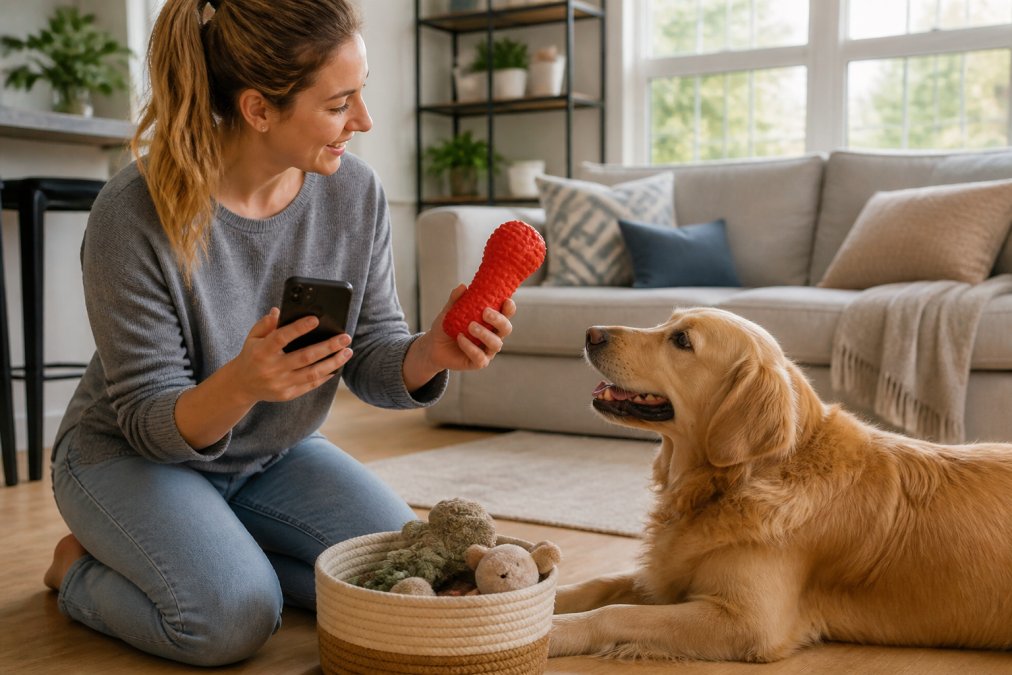
Non-toxic pet toy materials are those made without lead, phthalates, BPA, or heavy-metal dyes that can leach when a pet chews, licks, or swallows fragments. Since pets mouth toys for hours, material choice matters more than almost any other factor. The problem is that "non-toxic" is a marketing word, not a regulated one for pet toys, so the burden of verification falls on you.
Know Which Compounds to Avoid
A short list covers most of the risk:
- Phthalates, plasticizers that make vinyl soft and flexible; commonly found in cheap squeakers and vinyl toys. Look for "phthalate-free" rather than just "non-toxic."
- BPA (bisphenol A), used in some hard plastics and epoxy coatings. "BPA-free" is now a common label claim, but it should be paired with a named material.
- Lead and heavy metals, most often a risk in painted surfaces, metal hardware, and imported vinyl. Paint that flakes is a red flag.
- Formaldehyde and azo dyes, sometimes present in low-cost textiles and dyed plush. Untreated or naturally dyed fabric reduces exposure.
- Melamine and unlabeled "mystery plastic", if the label does not name the plastic, assume the worst.
Verify the Claim, Don't Trust the Word
Because pet toys are not held to the same mandatory federal testing as children's products, "non-toxic" on a pet toy label is largely self-declared. Here is how to verify it:
- Look for a named material. "Natural rubber," "food-grade silicone," "untreated cotton," and "BPA-free ABS" are verifiable. "Pet-safe material" is not.
- Look for a testing standard. ASTM references or an independent lab name (e.g., a third-party testing lab) indicate the manufacturer paid for verification. No standard listed means the claim is unverified.
- Check the country of origin and composition. A stated origin and material breakdown is a sign of a transparent supply chain.
- Smell the toy. A strong chemical or plastic odor out of the package is a signal to return it, not to air it out.
- Squeeze the toy. If you can feel a hard plastic squeaker through thin fabric, a determined chewer will find it too. Loose stuffing and squeakers are two of the most commonly ingested toy components and rarely appear on the outside label.
A Note on Plush and Synthetic Fibers
Synthetic fibers in plush toys deserve extra scrutiny. Loose stuffing, plastic squeakers, and glued-on eyes are the parts most likely to be swallowed. Prefer plush with stitched (not glued) features and reinforced seams, and treat any plush as a supervised toy for a pet that shreds.
Check Toy Labels for Material Testing Standards
Material testing standards are the third-party benchmarks a manufacturer uses to verify that safe pet toys are free of harmful substances. In the United States, the Consumer Product Safety Commission guidelines on children's product safety offer a useful reference point, since pet toys are not held to the same mandatory federal testing as children's products. That gap is exactly why labels matter.
Step 3: Choose Durable Materials for Your Pet's Chew Intensity
Durable materials only matter relative to your pet's chew intensity. A toy rated "indestructible" is useless if your dog ignores it, and a soft plush is dangerous for a dog that shreds and swallows. Match the material to the mouth, not the marketing.
Chew intensity generally falls into three tiers:
- Light chewers: plush toys, soft fabric, gentle fetch toys
- Moderate chewers: natural rubber, thick rope, reinforced stitching
- Aggressive chewers: dense rubber, hard nylon, and only toys explicitly rated for power chewers
Breed Jaw Strength and Rubber Hardness
Breed jaw strength varies far more than most owners assume, and it's the variable competitors ignore. A Labrador and a Chihuahua can weigh the same and generate wildly different bite force. Rubber hardness, often measured on the Shore A scale, tells you how much a toy resists deformation. Softer rubber (lower Shore A) suits gentle chewers; harder compounds suit power chewers but can crack teeth in the wrong mouth.
Step 4: Decide Between Interactive and Solo Play Toys
Interactive toys require you or another animal to participate. Solo toys are designed for independent play. Both have a place, but they carry different safety profiles, and interactive versus solo play safety is where most guides stay vague.
A simple decision rule:
| If your pet... | Choose | Why |
|---|---|---|
| Destroys toys quickly | Interactive, supervised | You can intervene before fragments are swallowed |
| Plays gently alone | Solo chew or puzzle toy | Safe for independent enrichment |
| Gets bored fast | Interactive smart toy | Movement and unpredictability hold attention |
| Is home alone for long stretches | Durable solo toy, rotated | Reduces boredom without constant supervision |
Step 5: Spot Signs of Worn-Out Pet Toys Before They Fail
Worn-out pet toys fail without warning, and the signs are almost always visible days before they do. Check every toy weekly, and check high-use toys every few days.
1 Piece USB Rechargeable Interactive →
Retire a toy immediately if you see:
- Cracks, splits, or a change in texture on rubber or nylon
- Exposed squeakers, loose stuffing, or torn seams
- Frayed rope ends that are shedding strands
- Missing pieces compared to when you bought it
- Any part that now fits fully inside your pet's mouth
Step 6: Learn How to Clean Pet Toys Safely
Knowing how to clean pet toys safely prevents bacterial growth that causes skin irritation and digestive upset. Toys collect saliva, dirt, and food residue, and a toy that smells off is usually a toy that's growing something.
Match the cleaning method to the material:
- Rubber and silicone: warm water, mild dish soap, scrub, air dry fully
- Machine-washable plush: laundry bag on a gentle cycle, no fabric softener, air dry
- Rope toys: hot water soak, then thorough drying to prevent mildew
- Electronic toys: wipe the surface only, never submerge unless the listing says it's waterproof
Step 7: Cross-Check Recalls and Supervise Play
Cross-checking recalls and supervising play are the two habits that catch what labels miss. Even a well-made toy can be recalled, and even a safe toy can fail in the mouth of the wrong chewer. Most guides tell you to "check for recalls" without explaining how, so here is the actual process.
How to Check Whether a Toy Has Been Recalled
Pet toys are not covered by the same mandatory recall framework as children's products, which means recalls are scattered across a few sources. Run this checklist before you buy a new toy and again if a toy starts failing:
- Search the manufacturer and product name against the Consumer Product Safety Commission recall database. Pet toys do not always appear there, but manufacturer recalls and material warnings often do.
- Check the manufacturer's own recall or safety page. Many brands post voluntary recalls and material warnings that never reach a federal database.
- Search the product name plus the word "recall" in a general web search. Voluntary recalls and news coverage often surface this way before they are formally listed.
- Check the retailer's product page for a recall notice or a discontinued listing. A sudden "no longer available" notice on a previously popular toy is worth investigating.
- Keep your receipt or order history. If a recall is issued, proof of purchase is what gets you a refund or replacement.
Supervise the Play, Not Just the Pet
Supervision is the backstop. Watch how your pet plays, not just that they are playing. A dog that pins a toy and gnaws at one seam is working toward a failure point. A cat that carries a small ball toward a stairwell is a fall risk. Redirect, swap the toy, and note what triggered the behavior so you can shop around it next time.
A few concrete patterns worth watching for:
- Seam-focused chewing, a pet that targets one seam is testing the weakest point. Rotate the toy out before it fails.
- Fragment swallowing, if you see pieces disappear, remove the toy immediately and check the mouth.
- Toy hoarding near hazards, small toys carried toward stairs, pools, or under furniture create fall and entrapment risks.
- Sudden loss of interest, a toy a pet loved and now ignores may have a hidden tear or a smell change worth investigating.
Interactive vs. Solo Play Safety
Interactive versus solo play safety is where most guides stay vague, and it matters most when you are not in the room. Interactive toys (fetch, tug, training rewards) are used with you present, so you can catch wear in real time. Solo toys (treat-dispensing balls, chew toys left in a crate) are used without you, so the safety margin has to be built into the toy itself.
Frequently Asked Questions
How do I choose the right size toy for my pet's breed?
Measure your pet's muzzle width and throat opening. A toy should be wider than the throat to prevent swallowing. For dogs, choose toys at least 2 inches wider than the muzzle. For cats, avoid anything smaller than a ping-pong ball. Always supervise new toys and remove small parts like squeakers or ribbons. If a toy fits entirely inside the mouth, it's a choking hazard.
What materials should I avoid when buying safe pet toys?
Avoid toys with small parts that can detach, like plastic eyes or bells. Skip soft plastics that crack into shards, and avoid rawhide or natural bones that splinter. Also steer clear of toys with strings longer than 6 inches due to tongue entrapment risk. Look for non-toxic, pet-safe labels and check for recalls before buying.
How often should I inspect my pet's toys for damage?
Inspect toys weekly for signs of wear and tear, including cracks, loose pieces, or exposed squeakers. For aggressive chewers, check daily. Replace any toy with deep gouges or missing parts immediately. Wash plush toys every two weeks to prevent bacterial growth. Rotate toys to extend their life and keep your pet engaged.
What are the signs of a choking hazard in pet toys?
Watch for toys smaller than your pet's throat opening, loose strings or ribbons, and detachable parts like eyes or squeakers. Also avoid toys with sharp edges or exposed wires. If a toy can fit entirely in your pet's mouth, it's a risk. Supervise play and remove damaged toys right away.