

Table of Contents
- Step 1: Spot the Signs of an Understimulated Dog
- Step 2: How to Tire Out a Dog Before Work
- Step 3: Build a Daily Routine That Prevents Boredom
- Step 4: Pick the Best Interactive Dog Toys for Mental Stimulation
- Step 5: Use Scent Work and Foraging for Cognitive Engagement
- Step 6: Set Up Pet Cameras and Safety Protocols for Unsupervised Play
- Step 7: Match Enrichment to Your Dog's Age and Breed
- Frequently Asked Questions
Last Updated: September 28, 2026
Step 1: Spot the Signs of an Understimulated Dog
A bored dog usually tells you before the damage starts, but most owners read the signals as bad behavior instead of noticing that dogs stimulated by nothing all day are simply asking for engagement.
Watch for these behavioral red flags:
- Chewing furniture, shoes, or baseboards
- Pacing, whining, or barking at nothing
- Digging at carpets or scratching doors
- Following you room to room all day
- Ignoring toys and staring at you instead
Step 2: How to Tire Out a Dog Before Work
The most effective way to tire out a dog before work is 20 to 30 minutes of real physical activity, not a quick trip to the yard. A short walk around the block rarely touches a high-energy dog's reserves.
Morning Exercise That Actually Works
Match the activity to the dog, not to your schedule:
- Fetch or flirt pole: 15 minutes of sprinting beats 45 minutes of walking
- Sniff-heavy walks: let the dog lead and stop often; scent work tires dogs faster than distance
- Tug: short bursts build focus and burn energy
- Puzzle feeders at breakfast: make the dog work for the first meal
Step 3: Build a Daily Routine That Prevents Boredom
Dogs thrive on predictability, and a routine does more for boredom than any single toy. When your dog knows what happens next, waiting stops feeling like abandonment.
Build the day in blocks:
| Time | Activity | Purpose |
|---|---|---|
| 7:00 a.m. | Exercise + breakfast | Burn energy, satisfy foraging |
| 8:00 a.m. | Settle time with a chew | Wind down before you log on |
| 12:00 p.m. | Puzzle toy or frozen treat | Midday mental break |
| 3:00 p.m. | Short walk or potty break | Physical reset |
| 5:30 p.m. | Training + play | Reconnect after work |
Step 4: Pick the Best Interactive Dog Toys for Mental Stimulation
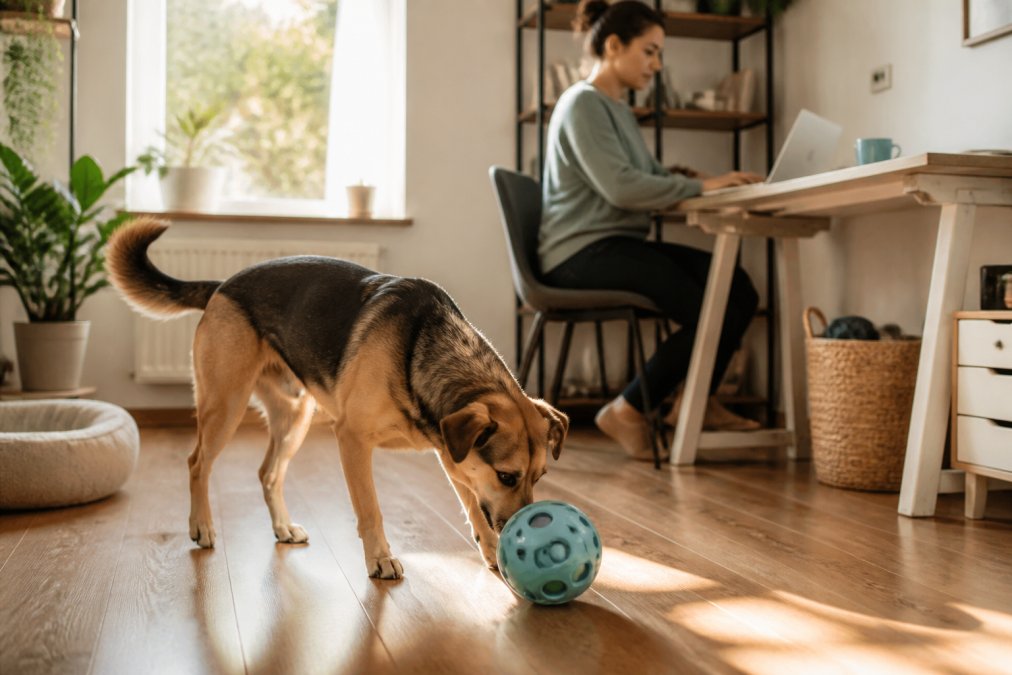
The best interactive dog toys for mental stimulation make your dog solve a problem, not just chase something. Chewing and chasing are fine, but thinking drains energy. Whether a toy occupies your dog for four minutes or forty comes down to three variables: difficulty, food value, and novelty.
The Three Variables That Decide Whether a Toy Works
Difficulty. A puzzle your dog solves in 20 seconds becomes a bowl with extra steps. The sweet spot is roughly 30 seconds to several minutes of active problem-solving per round. If your dog walks away after one sniff, it is too hard; if they finish before you sit down, it is too easy. Most adjustable puzzles start with one or two hidden compartments and add more as your dog gets fluent.
Puzzle Toys, Snuffle Mats, and Chew Toys
Each type does a different job, and they are not interchangeable:
- Puzzle toys hide treats behind sliders, flaps, and drawers; best for problem-solvers and dogs that already know how to nose a treat out of a container
- Snuffle mats mimic foraging and slow down fast eaters; a good fit for dogs that inhale meals in under a minute
- Chew toys provide calm, repetitive stress relief; the right chew can settle a dog for 20 to 30 minutes with almost no supervision
- Rolling treat balls combine movement with reward; useful for dogs that need to move, not just think
- Lick mats spread soft food across a textured surface; licking is a self-soothing behavior and works well as a wind-down after exercise
Toy Rotation: The Trick Nobody Tells You About
Keep three or four toys out and store the rest, swapping them weekly, a "new" toy holds attention far longer than the same one left out for a month. The rotation does not need to be complicated:
- Week A: puzzle toy, snuffle mat, one chew, one rolling ball
- Week B: swap the puzzle for a different puzzle, swap the chew for a different texture, keep the rolling ball
- Week C: bring back the Week A puzzle; by now it feels new again
Match the Toy to the Dog, Not the Aisle
A few rules of thumb:

- Heavy chewers destroy plush and thin rubber in minutes; choose natural rubber or nylon rated for power chewers, and check for cracks after every session
- Senior dogs do better with soft, food-stuffed toys and lick mats than hard puzzles requiring sharp hearing or fast movement
- Flat-faced breeds overheat quickly, so favor stationary puzzle toys over anything that requires running
- Dogs that give up easily need the easiest setting first; confidence builds engagement, so add difficulty once they win consistently
Step 5: Use Scent Work and Foraging for Cognitive Engagement
Scent work is the most underrated tool for keeping dogs stimulated while working, because it tires the brain faster than the body. Ten minutes of nose work can do more than a mile of walking.
Try these:
- Scatter kibble across a towel and roll it up
- Hide treats in cardboard boxes for the dog to shred
- Play hide-and-seek with a favorite toy around the house
- Set up a simple treat trail from room to room
Mental work drains a dog's energy more efficiently than physical work. A 15-minute scent game often outperforms a 30-minute walk for a high-energy dog.
Step 6: Set Up Pet Cameras and Safety Protocols for Unsupervised Play
A pet camera turns guesswork into data: you learn whether your dog sleeps, paces, or destroys things while you're gone, and adjust the plan accordingly.
1 Piece USB Rechargeable Interactive →
Safety rules for unsupervised play matter just as much:
- Remove toys with loose strings, squeakers, or small parts
- Skip rope toys that can unravel into strands
- Choose toys sized so they cannot be swallowed
- Check toys weekly for cracks and tears
- Keep electrical cords and trash out of reach
Step 7: Match Enrichment to Your Dog's Age and Breed
Enrichment is not one-size-fits-all: a puppy, an adult working breed, and a senior dog need very different plans. Most guides stop at "know your dog", here is what that looks like by life stage and breed group.
Age-Appropriate Stimulation
Puppies (under about 6 months). The goal is short, frequent, positive exposure, not tiring them out. A puppy's growth plates are still open, so avoid long forced runs, repetitive jumping, and miles of pavement. Instead:
-
Three to five short play sessions of 5 to 10 minutes each
-
Name-and-treat games that build attention
-
Chew toys appropriate for baby teeth (softer than adult chews)
-
Crate or pen time with a stuffed food toy to practice settling
-
Nose work and scatter feeding, which need almost no mobility
-
Softer chews and lick mats for dogs with worn or missing teeth
-
Shorter, more frequent walks on flat ground
-
Memory games like find-the-toy, which keep cognition engaged
Breed-Specific Stimulation Requirements
- Herding breeds (Border Collie, Australian Shepherd, Heeler) were bred to work all day and read movement. They often need cognitive work more than cardio, a puzzle they solve is more tiring than a run they finish. Training games, trick work, and scent tasks tend to land better than another lap around the block.
- Working and sporting breeds (Labrador, Golden Retriever, German Shepherd, Husky) were built for sustained physical effort and often need both a real exercise block and a job to do. Retrieving games, structured fetch, and food-dispensing toys that require movement fit them well.
- Terriers were bred to hunt small prey and dig. Dig boxes, flirt poles, and treat-hiding games channel that drive better than trying to suppress it.
- Toy and companion breeds (Chihuahua, Maltese, Cavalier) often do fine with a single puzzle toy, a short walk, and a daily training session. Over-exercising them is a bigger risk than under-exercising them.
- Flat-faced (brachycephalic) breeds (Pug, French Bulldog, Boston Terrier) overheat quickly and can struggle to breathe during intense activity. Favor scent games, lick mats, and stationary puzzles over running or long walks in heat.
- Giant breeds (Great Dane, Mastiff) need gentle, low-impact activity and are prone to bloat, so avoid vigorous play right after meals.
If you want one tool that fits a range of pets, the ROJECO Automatic Cat Feeder lets you schedule small meals through the day, which turns feeding into a series of small, predictable events. It works for both cats and dogs and runs on WiFi.

Frequently Asked Questions
How can I tell if my dog is understimulated while I work?
Signs include destructive chewing, excessive barking, pacing, and loss of interest in toys. A dog that stares at walls or sleeps constantly may also need more mental stimulation. Try a pet camera to monitor behavior during the day. If your dog ignores puzzle toys or snuffle mats, increase difficulty or rotate toys weekly.
Are puzzle feeders effective for dog mental stimulation?
Yes, puzzle feeders mimic foraging and require problem-solving, which tires dogs out faster than physical exercise alone. Start with easy feeders and increase difficulty. Freeze wet food inside for longer engagement. Rotate feeders every few days to prevent boredom. Most dogs stay engaged for 15 to 30 minutes per session.
How long can I leave my dog alone while working?
Most adult dogs can handle 4 to 6 hours alone, but puppies and seniors need more frequent breaks. If you work 9 hours, hire a dog walker or use daycare. Set up a pet camera to check in. Provide a frozen treat or interactive toy before you leave. Crate training helps only if your dog sees the crate as a positive space.
What are the best interactive toys for dogs while working?
USB rechargeable interactive toy balls, treat-dispensing puzzle toys, and snuffle mats work well. The ROJECO Automatic Cat Feeder can also dispense kibble on a schedule to keep dogs engaged. Rotate toys daily and use high-value frozen treats in chew toys. Always supervise initially to ensure safety.