

Table of Contents
- Quick Comparison: Safe Home Products for Young Kids
- Best Childproofing Safety Devices That Actually Work
- Non-Toxic Household Cleaners for Families: What to Look For
- How to Childproof a Home Room by Room
- Smart Home Safety Integration: Cameras and Monitoring
- Budget-Friendly DIY Safety Hacks and Eco-Friendly Disposal
- Conclusion: Building a Safer Home for Young Kids
- Frequently Asked Questions
Last Updated: September 20, 2026
Quick Comparison: Safe Home Products for Young Kids
Building a genuinely safe home for young kids comes down to a short list of products: cabinet locks, outlet covers, furniture anchors, baby gates, and non-toxic cleaners. This guide from NextGen breaks down which safe home products for young kids earn their place, where they fail, and how to install them without wrecking a rental.
Most parents overspend on gadgets and underspend on the boring stuff. Anchoring a bookshelf costs almost nothing and prevents the injury that sends the most kids to the emergency room. A $40 camera is nice. A $4 strap is essential.
Below, we rank the categories by real-world impact, show you what to buy at each age, and flag the mistakes that show up again and again. The Consumer Product Safety Commission tracks these incidents, and the pattern is consistent: falls, poisonings, and tip-overs dominate.
| Product Category | Typical Cost | Age Range | Impact |
|---|---|---|---|
| Furniture anchors | Under $20 | 6 months+ | Prevents tip-over deaths |
| Cabinet locks | $15-30 | 9 months+ | Blocks chemical access |
| Outlet covers | Under $15 | 6 months+ | Prevents shock and burns |
| Baby gates | $30-70 | 6-24 months | Blocks stairs and kitchens |
| Window guards | $20-40 | 12 months+ | Prevents falls from height |
Best Childproofing Safety Devices That Actually Work
The best childproofing safety devices are the ones a determined toddler cannot defeat in under two minutes. That rules out most adhesive products on painted cabinets and most pressure-mounted gates at the top of stairs.
Magnetic cabinet locks win on security: they mount inside the door, stay invisible, and require a key you keep on the fridge. The trade-off is drilling. Adhesive latches take thirty seconds and fail within months on humid bathroom cabinets. Use adhesive for drawers a toddler rarely opens; use magnetic for anything holding bleach.
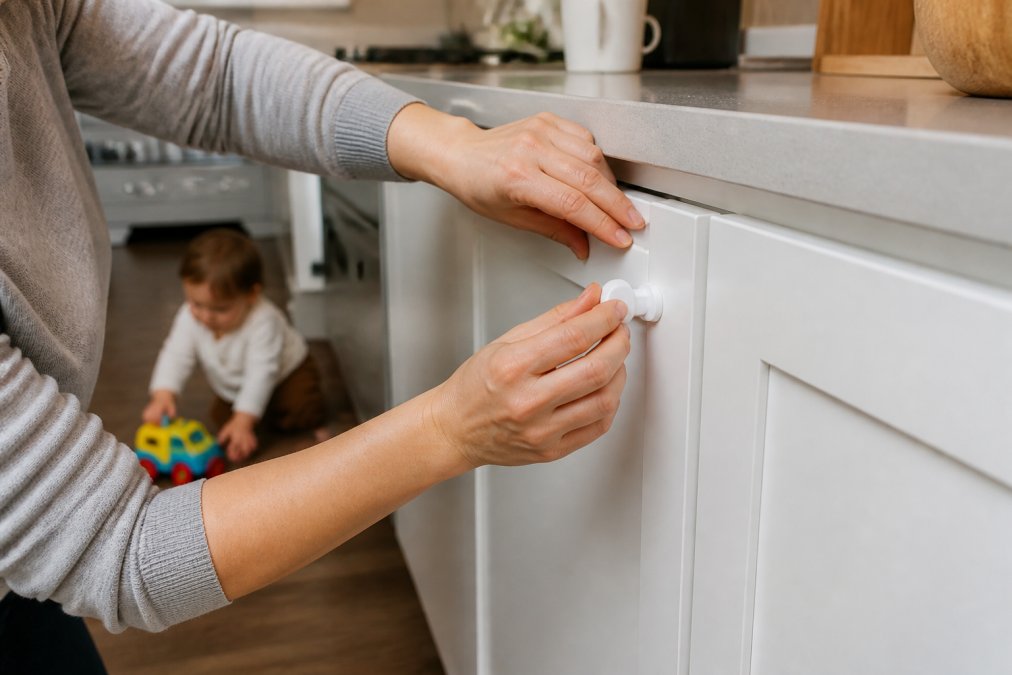
Cabinet Locks and Latches: Magnetic vs. Adhesive
Magnetic locks are worth the drilling for kitchens and bathrooms. Adhesive latches are a stopgap for low-traffic drawers.
A common mistake is installing adhesive latches above a dishwasher or under a sink, where heat and moisture break the bond right when you need it most.
Outlet Covers, Corner Guards, and Baby Gates
Slide-in outlet covers beat plug-in plastic caps, which toddlers pry out and choke on. Corner guards matter most on coffee tables and hearths at crawling height.
For gates, hardware-mounted units belong at the top of stairs.
Non-Toxic Household Cleaners for Families: What to Look For
Non-toxic household cleaners for families are formulated without ingredients linked to acute poisoning or long-term respiratory harm. But "non-toxic" is not a regulated term on a bottle. Understanding what the label tells you, and hides, is the difference between a safe cabinet and a greenwashed one.
Reading Labels: Ingredients to Avoid and Why
Skip cleaners containing chlorine bleach, ammonia, and quaternary ammonium compounds if you have a crawling child, these cause the most severe accidental ingestion injuries. Bleach and ammonia release corrosive vapors that damage the esophagus on contact, and mixing them (even accidentally) produces chloramine gas. Quaternary ammonium compounds, the "quats" listed as benzalkonium chloride or alkyl dimethyl benzyl ammonium chloride, are linked to asthma exacerbation in young children and persist on surfaces long after the bottle is capped.
How to Decode a Safety Data Sheet
Every household cleaning product has a Safety Data Sheet (SDS) available from the manufacturer, even if it isn't posted online. The SDS is a standardized document, not marketing copy. Section 2 lists hazard identification, Section 3 the exact chemical composition and concentration ranges, and Section 4 first-aid measures, the section you want open if an ingestion happens.
Certification Programs Worth Trusting
Third-party certifications do the label-reading for you, but they are not interchangeable. The EPA Safer Choice program reviews every ingredient against a published list of chemicals of concern and requires the manufacturer to disclose the full formula to the EPA. Green Seal certifies against lifecycle criteria including aquatic toxicity and packaging. A "Safer Choice" mark means the EPA has seen the formula; a store-brand "eco" badge means a marketing team approved it.
How to Childproof a Home Room by Room
Childproofing works best as a room-by-room risk assessment rather than one big shopping trip. Walk each room at your child's eye level, identify hazards, then buy only what that room needs. But hazards change as your child does, a crawling infant and a climbing toddler face different risks in the same room. Childproofing isn't a one-time checklist; it's a moving target, and the room-by-room approach only works layered with age-specific safety tiers.
Smart Robot Camera 3MP IP Camera WIFI →
The Three Mobility Tiers
Crawling (roughly 6-12 months). The threat is what's at floor level and within arm's reach from a seated or crawling position. Outlet covers, furniture anchors, and gates at stairs are the priorities. Cabinet locks matter less, a crawler can't open a door with leverage, but can reach a low shelf, a pet bowl, or a dropped medication. Get on the floor and look at what's within 18 inches of the ground.
Kitchen and Bathroom: High-Risk Zones
Lock every cabinet below counter height. Move cleaners, medications, and sharps to a high shelf, ideally in a locked box. Add a stove knob cover and a fridge lock if your child is a climber. The stove is the most underrated kitchen hazard for the climbing tier, a toddler who can reach a knob can turn on a gas burner and not understand what's happening.
Living Room and Bedroom: Furniture Anchors and Window Guards
Anchor every dresser, bookshelf, and TV. Furniture anchors are the single highest-value safety purchase you can make, a dresser that tips can kill a child in seconds. A 30-pound toddler pulling on an open drawer can generate enough leverage to topple a 70-pound dresser, and the child's head takes the impact.
Reassess on a Schedule, Not on a Feeling
Re-walk every room at each of the three mobility tiers, when your child starts crawling, walking, and climbing. Between tiers, do a quick monthly scan for new hazards: a new houseplant, a new piece of furniture, a new bottle of cleaner that didn't get locked up. The room doesn't change. Your child does.
Smart Home Safety Integration: Cameras and Monitoring
Smart home safety integration means using connected cameras and monitors to watch high-risk zones without hovering. A camera in a nursery or playroom lets you check on a sleeping child or catch a climbing toddler before an accident.
| Feature | Robot Camera 3MP | Wireless WiFi Camera |
|---|---|---|
| Price | $35.00 | $27.00 |
| Resolution | 3MP | 1080p |
| Pan/Tilt | 350° / 90° | Fixed |
| AI detection | Yes | No |
| Best for | Playrooms | Single-angle spots |
Budget-Friendly DIY Safety Hacks and Eco-Friendly Disposal
Budget-friendly childproofing is possible if you spend on anchors and locks and improvise the rest, you don't need a $200 safety kit.
DIY options that hold up:
- Cut pool noodles to length for table edge padding
- Use a tension rod to block a low cabinet opening
- Repurpose a mesh laundry bag as a small-item barrier
- Route cords behind furniture with adhesive clips
- Lock a cabinet with a simple child-resistant strap
Conclusion: Building a Safer Home for Young Kids
The hard part of childproofing isn't buying products, it's staying ahead of a child who gets taller and more curious every month. Start with anchors and locks, add monitoring where it helps, and reassess each room as your child grows.
Frequently Asked Questions
What are the most essential child safety products for a home?
Start with cabinet locks, outlet covers, baby gates, and furniture anchors. These address the top injury risks: poisoning, electrical shock, falls, and tip-overs. Add corner guards for sharp edges and window guards for upstairs rooms. A video doorbell or indoor camera can also help monitor play areas and entryways.
How can I identify non-toxic household cleaners for families?
Avoid products with fragrance, chlorine bleach, or ammonia. The EPA Safer Choice label is a reliable third-party certification. For families with toddlers, store all cleaners in locked cabinets to prevent accidental ingestion.
What are the common household hazards to look for when childproofing?
Focus on five areas: unsecured furniture (tip-over risk), accessible cleaning supplies (poisoning), uncovered outlets (electrical shock), sharp corners (cuts), and windows without guards (falls). Also check for small objects that can cause choking, like coins or batteries. A room-by-room walkthrough helps you spot hazards at your child's eye level, including dangling cords and unstable decor.
Are there smart home devices that improve child safety?
Yes. Indoor cameras with AI human detection, like the Smart Robot Camera 3MP IP Camera, can alert you if a child enters a restricted area. Video doorbells, such as the Wireless Security Smart WiFi Doorbell, let you see and talk to visitors remotely. These devices add a layer of monitoring, but they do not replace physical barriers like locks and gates.
What safety standards should I look for when buying products for kids?
Non-toxic cleaners may carry the EPA Safer Choice label. Always follow the manufacturer's age and weight limits, and install products exactly as directed.